How a Simple Idea Becomes a Real Product
Every product you use started as an idea.
The smartphone in your pocket, the coffee mug on your desk, the app you opened this morning, and even the chair you’re sitting on all began with someone asking a simple question: What if there was a better way to do this?
It’s easy to look at finished products and assume they appeared fully formed. In reality, the journey from idea to product is usually long, uncertain, and filled with testing, revisions, and problem-solving.
Whether it’s a physical product or a digital service, bringing an idea to life follows a process that turns imagination into something people can actually use.
It starts with identifying a problem
Many successful products don’t begin with a brilliant invention—they begin with a problem.
Perhaps a task is too slow, too expensive, too complicated, or simply frustrating.
Great entrepreneurs and designers often pay close attention to everyday inconveniences. Instead of accepting them, they ask questions like:
- Why is this so difficult?
- Could this be simpler?
- Is there a better solution?
The stronger the problem, the more valuable the solution can become.
In many cases, people don’t buy products because they’re innovative. They buy them because they solve real problems.
The idea takes shape
Once a problem has been identified, it’s time to brainstorm possible solutions.
At this stage, ideas are rarely perfect.
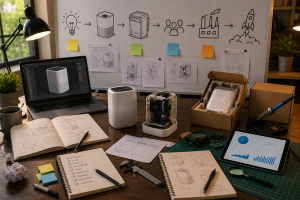
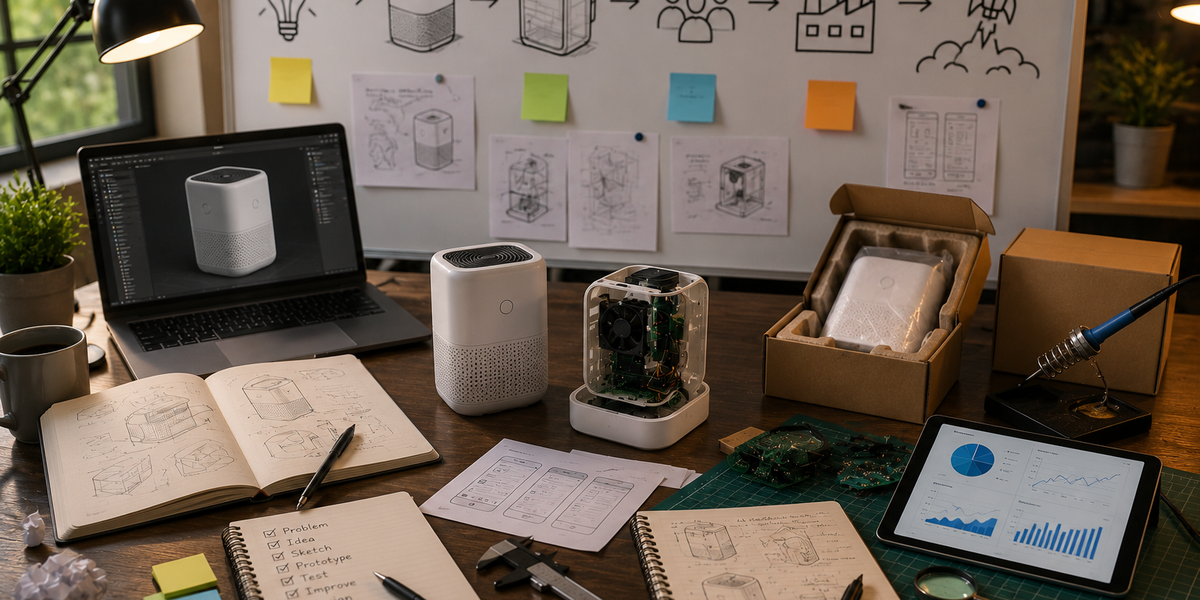
Designers sketch concepts, create notes, build simple diagrams, and discuss different possibilities. The goal isn’t to create the final product immediately but to explore different approaches.
Many ideas are discarded during this stage, while others evolve into something much better than the original concept.
Creativity is important, but so is flexibility.
The best ideas often improve significantly before anyone builds them.
A prototype brings the idea to life
Before investing large amounts of time and money, most companies create a prototype.
A prototype is an early version of the product designed to test the basic concept.
For a physical product, this might be a 3D-printed model or a handmade sample.
For software, it could be a simple interactive design or an early version of an app with limited features.
The purpose isn’t perfection.
It’s to answer one important question:
Does this idea actually work?
Building a prototype often reveals problems that weren’t obvious on paper.
Testing leads to improvement
Very few products succeed on the first attempt.
After building a prototype, companies test it with real users.
They observe how people interact with the product, what they find confusing, what works well, and what needs improvement.
Sometimes users discover problems the creators never anticipated.
This feedback is incredibly valuable because it helps refine the product before it reaches a wider audience.
Many of today’s most successful products went through dozens—or even hundreds—of revisions before launch.
Design is about more than appearance
When people think about product design, they often focus on how something looks.
In reality, good design is just as much about how something works.
A well-designed product should be easy to understand, comfortable to use, and capable of solving the problem it was created to address.
Designers consider questions like:
- Is it intuitive?
- Is it reliable?
- Is it accessible?
- Is it enjoyable to use?
A beautiful product that frustrates users rarely succeeds for long.
The best products combine functionality with simplicity.
Manufacturing or development begins
Once the design has been refined, production begins.
For physical products, this involves selecting materials, finding manufacturers, testing quality, and organizing supply chains.
For digital products, developers write code, fix bugs, improve performance, and prepare the software for launch.
This stage often requires collaboration between engineers, designers, marketers, manufacturers, and business teams.
Turning an idea into a finished product is rarely the work of one person alone.
It’s usually the result of many people contributing different skills.
Launching is only the beginning
Many people think a product is finished once it’s released.
In reality, launching is often the start of a new phase.
Companies continue collecting customer feedback, fixing issues, improving features, and releasing updates.
Software apps may receive updates every few weeks. Physical products often evolve into improved versions based on customer experiences.
Successful products rarely stay exactly the same.
They continue adapting as technology changes and customer needs evolve.
Not every idea becomes a success
It’s important to remember that having an idea is only one small part of the process.
Many excellent ideas never become successful products.
Some solve problems that aren’t important enough. Others arrive too early or too late. Some are too expensive to produce, while others struggle because customers prefer existing alternatives.
Success depends on far more than creativity.
Execution, timing, testing, persistence, and understanding customers are often just as important as the original idea itself.
Every product has a story
The next time you pick up your phone, use an app, or buy something new, remember that it almost certainly started as a simple idea.
Someone noticed a problem, imagined a better solution, tested countless versions, listened to feedback, solved unexpected challenges, and kept improving until the product was ready for the world.
That’s how innovation usually happens—not through one moment of inspiration, but through many small steps that gradually transform an idea into something real.
Behind every successful product is a journey of experimentation, persistence, and continuous improvement. And it all begins with a simple question: What if there were a better way?