How AI Actually Works (No Math Required)
Artificial intelligence seems almost magical.
You type a question into a chatbot, and it responds in seconds. Your phone recognizes faces in photos. Streaming platforms recommend movies you’ll probably enjoy. Translation apps understand dozens of languages almost instantly.
It’s easy to assume that AI somehow “thinks” like a human.
In reality, artificial intelligence works in a very different way. While the technology behind it is incredibly complex, the basic ideas are surprisingly easy to understand. You don’t need to know advanced mathematics or computer science to grasp what’s happening behind the scenes.
Here’s a simple explanation of how AI actually works.
AI learns from patterns, not understanding
One of the biggest misconceptions about AI is that it thinks like people do.
It doesn’t.
Instead, AI is extremely good at recognizing patterns.
Imagine showing a child thousands of pictures of cats and dogs. Over time, the child starts noticing patterns—cats usually have certain features, while dogs have others.
AI learns in a similar way.
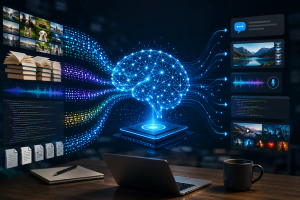
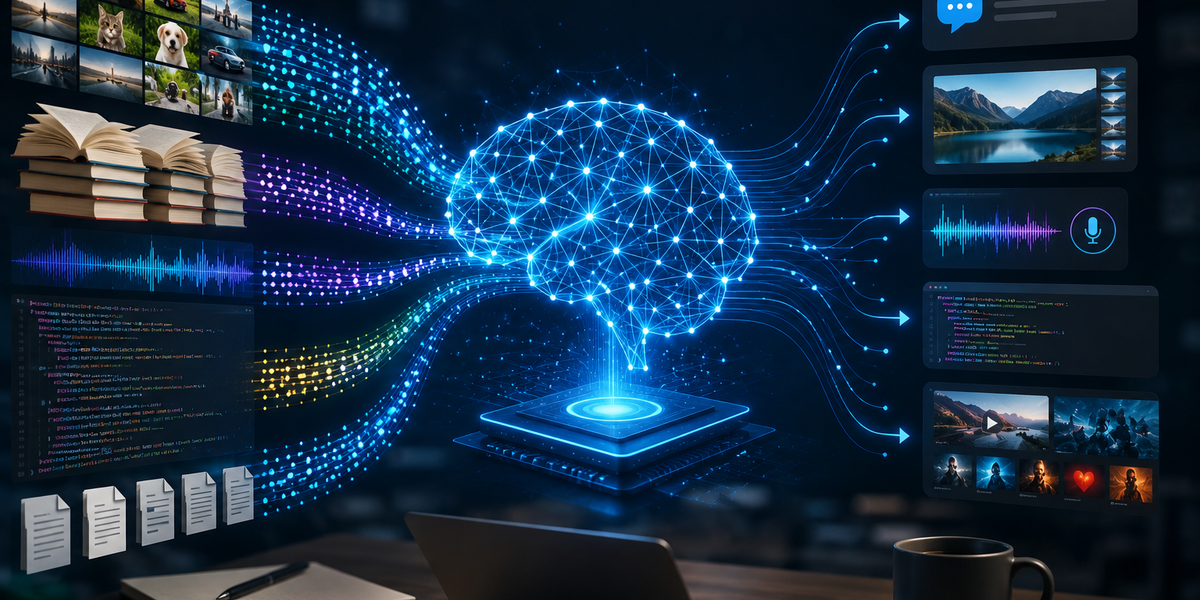
Instead of being manually programmed with every possible rule, it analyzes enormous amounts of data and gradually learns to recognize patterns within it.
Those patterns allow it to make predictions or generate responses when it encounters something new.
Training comes before using AI
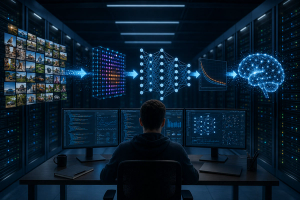
Before AI can answer questions or recognize images, it first has to be trained.
Training is the process of exposing an AI system to massive amounts of information.
For example:
- An image-recognition AI may analyze millions of labeled photographs.
- A language model may learn from books, articles, websites, and other written material.
- A music recommendation system studies listening habits from millions of users.
During training, the AI isn’t memorizing everything word for word.
Instead, it’s learning relationships between pieces of information and identifying recurring patterns.
This training phase can take weeks or even months using extremely powerful computers.
AI makes predictions
Once training is complete, the AI is ready to make predictions.
This is the part most people interact with.
For example, when you begin typing a message and your phone suggests the next word, it’s predicting which word is most likely to come next based on patterns it has learned.
The same principle applies to many AI systems.
A recommendation algorithm predicts which movie you’ll probably enjoy.
A navigation app predicts the fastest route.
An email filter predicts whether a message is spam.
A chatbot predicts which words are most likely to form a helpful response to your question.
In many ways, AI is a highly sophisticated prediction machine.
Large language models work one word at a time
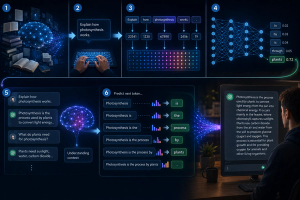
Modern AI chatbots may appear to write entire paragraphs at once, but that’s not actually what happens.
Instead, they generate responses one word—or more accurately, one small piece of text—at a time.
After reading your prompt, the AI predicts which word is most likely to come next.
Then it predicts the next one.
Then the next.
This process happens incredibly quickly, allowing complete sentences and paragraphs to appear almost instantly.
Although the results can feel conversational, the AI is continuously making predictions based on patterns it learned during training.
AI doesn’t know facts the way humans do
This is an important distinction.
People often imagine AI as having a giant database of facts that it searches whenever someone asks a question.
That’s not how most modern AI systems work.
Instead of retrieving stored answers, they generate responses based on learned patterns.
This is why AI can sometimes make mistakes or confidently produce incorrect information.
It isn’t intentionally misleading anyone—it is simply generating the response that appears most likely based on everything it has learned.
For this reason, important information should always be verified using reliable sources.
Why AI keeps improving
Artificial intelligence has advanced rapidly over the past decade for several reasons.
First, researchers now have access to enormous amounts of digital data.
Second, computers have become dramatically more powerful, allowing AI systems to process far more information than ever before.
Finally, improvements in algorithms—the methods AI uses to learn—have made these systems more accurate and efficient.
Together, these advances have enabled AI to perform tasks that once seemed impossible, including generating realistic images, translating languages, writing code, and carrying on natural conversations.
What AI can and can’t do
AI is incredibly capable, but it also has limitations.
It excels at identifying patterns, processing large amounts of information, generating text, recognizing images, and performing repetitive tasks.
However, it doesn’t experience emotions, possess personal opinions, or understand the world in the same way humans do.
It has no memories of childhood, no personal experiences, and no independent desires.
Its responses are based on statistical patterns rather than human consciousness.
Understanding this difference helps explain both AI’s impressive abilities and its occasional mistakes.
A powerful tool built on patterns
Artificial intelligence may seem mysterious, but its core idea is surprisingly straightforward.
It learns from enormous amounts of data, identifies patterns, and uses those patterns to make predictions.
Whether it’s recommending a movie, recognizing a face, translating a sentence, or answering a question, AI isn’t performing magic. It’s applying what it has learned to predict the most likely outcome.
As AI continues to improve, it will become an even bigger part of everyday life.
The more we understand how it works, the better equipped we’ll be to use it wisely, recognize its strengths, and appreciate its limitations.