The Strange Science of Why We Dream
Almost everyone dreams.
Some dreams are so vivid they stay with us for years. Others disappear within moments of waking up. We might dream about flying, revisiting childhood memories, meeting people we’ve never seen before, or finding ourselves in situations that make no logical sense.
For centuries, people believed dreams carried hidden messages or predicted the future. Today, scientists have a better understanding of what happens when we dream—but surprisingly, they still don’t know exactly why dreams exist.
What researchers do know is that dreaming is a normal part of sleep, and it appears to play an important role in how our brains process emotions, memories, and experiences.
Here’s what science currently tells us about the strange world of dreams.
Dreams happen during specific stages of sleep
Sleep isn’t one continuous state.
Instead, it moves through several stages that repeat in cycles throughout the night.
One of the most important is Rapid Eye Movement (REM) sleep.
During REM sleep, your brain becomes highly active, almost as active as when you’re awake. At the same time, most of your body’s muscles are temporarily relaxed, preventing you from physically acting out your dreams.
Although dreams can occur during other stages of sleep, the most vivid, detailed, and emotional dreams usually happen during REM sleep.
As the night progresses, REM periods become longer, which is why people often remember dreams that occur shortly before waking.
Your brain stays busy while you sleep
Even though you’re unconscious, your brain doesn’t shut down.
In fact, while you sleep, it continues performing many important tasks.
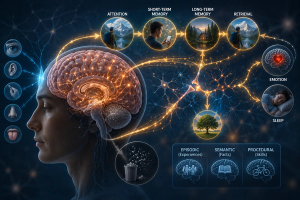
Researchers believe the brain uses this time to organize memories, strengthen learning, process emotions, and filter through the enormous amount of information collected during the day.
Dreaming may simply be one result of these behind-the-scenes activities.
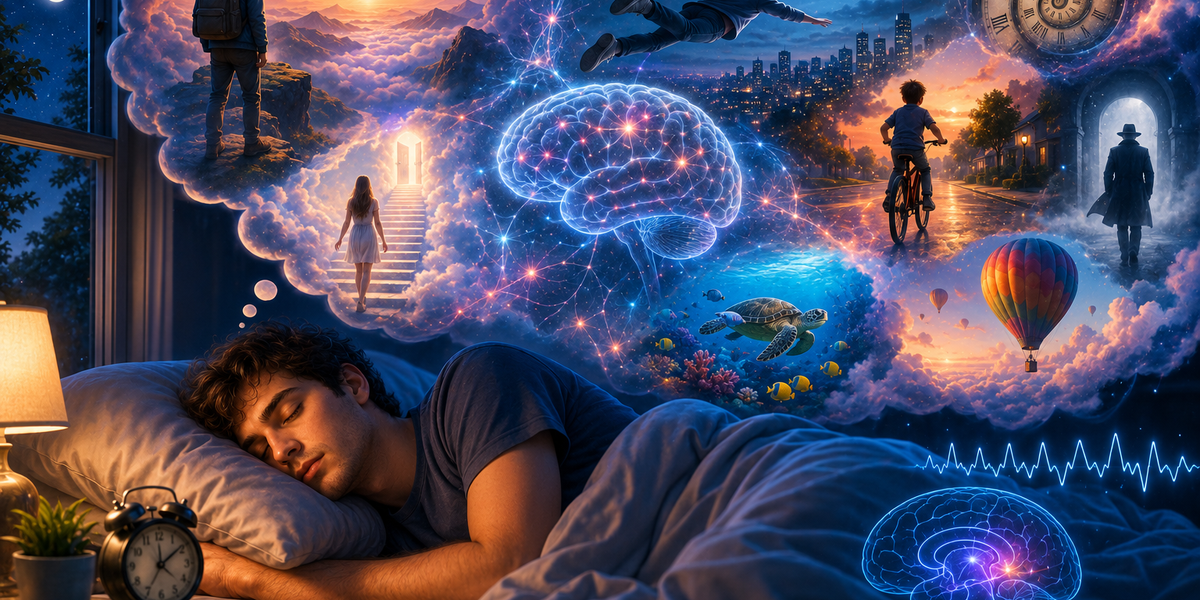
As different parts of the brain communicate and process experiences, they may combine memories, emotions, and imagination into the stories we experience as dreams.
Dreams may help process emotions
One leading theory is that dreams help us process emotions.
Stressful conversations, exciting events, fears, hopes, and unresolved problems often appear in dreams in unexpected ways.
Rather than replaying events exactly as they happened, the brain mixes memories together, creating strange scenarios that may help us work through emotional experiences.
This could explain why people often dream more vividly during periods of stress, major life changes, or emotional challenges.
Although scientists continue studying this idea, many researchers believe dreams contribute to emotional well-being.
Dreams mix memories with imagination
Have you ever dreamed about someone from school standing in your current workplace while talking to a family member you’ve never introduced them to?
Dreams often combine unrelated memories into entirely new situations.
The brain appears to pull pieces from different experiences and blend them together.
A place you visited years ago might appear alongside someone you saw yesterday. Familiar faces may appear in unfamiliar settings.
This unusual mixing of memories is one reason dreams often feel both realistic and completely bizarre at the same time.
Why dreams often don’t make sense
One of the strangest things about dreams is how easily we accept impossible situations.
You might suddenly fly, breathe underwater, or change locations instantly without questioning any of it.
Scientists believe this happens because the parts of the brain responsible for logical reasoning and critical thinking are less active during dreaming.
Meanwhile, areas involved in emotion, imagination, and visual processing remain highly active.
As a result, dreams can feel completely believable while they’re happening, even when they ignore the normal rules of reality.
Why we forget most dreams
Most dreams disappear surprisingly quickly.
Within just a few minutes of waking up, many people can remember only fragments—or nothing at all.
Researchers aren’t entirely certain why this happens.
One possibility is that the brain simply doesn’t store dream experiences as long-term memories in the same way it stores waking events.
Another idea is that the chemicals involved in memory formation change during different stages of sleep, making dreams more difficult to remember.
Whatever the reason, forgetting dreams appears to be completely normal.
Do dreams have hidden meanings?
For centuries, people have searched for symbolic meanings behind dreams.
While certain themes—such as falling, being chased, or arriving late—are common across many cultures, modern science has found little evidence that dreams follow a universal code with fixed meanings.
Instead, dreams appear to be highly personal.
The same dream may represent something entirely different for two different people because it reflects their own memories, emotions, and experiences.
Rather than predicting the future, dreams are generally thought to reflect how the brain processes the past and present.
Scientists are still searching for answers
Despite decades of research, dreams remain one of neuroscience’s biggest mysteries.
Researchers continue investigating questions such as:
- Why do some dreams feel so realistic?
- Why are some dreams frightening while others are enjoyable?
- Why do certain dreams repeat?
- Why do people remember some dreams but forget most others?
Although many theories exist, no single explanation fully answers all of these questions.
Dreaming remains an active area of scientific research.
One of the brain’s greatest mysteries
Every night, our brains create vivid worlds filled with people, places, emotions, and stories that often disappear by morning.
While scientists now understand much more about when dreams occur and what parts of the brain are involved, the exact purpose of dreaming is still being explored.
What seems most likely is that dreams are connected to memory, learning, emotional processing, and the incredible complexity of the sleeping brain.
The next time you wake from a strange dream, remember that you’re experiencing one of the most fascinating—and least understood—processes in human biology.
Even after centuries of study, the science of dreaming still holds many secrets waiting to be discovered.