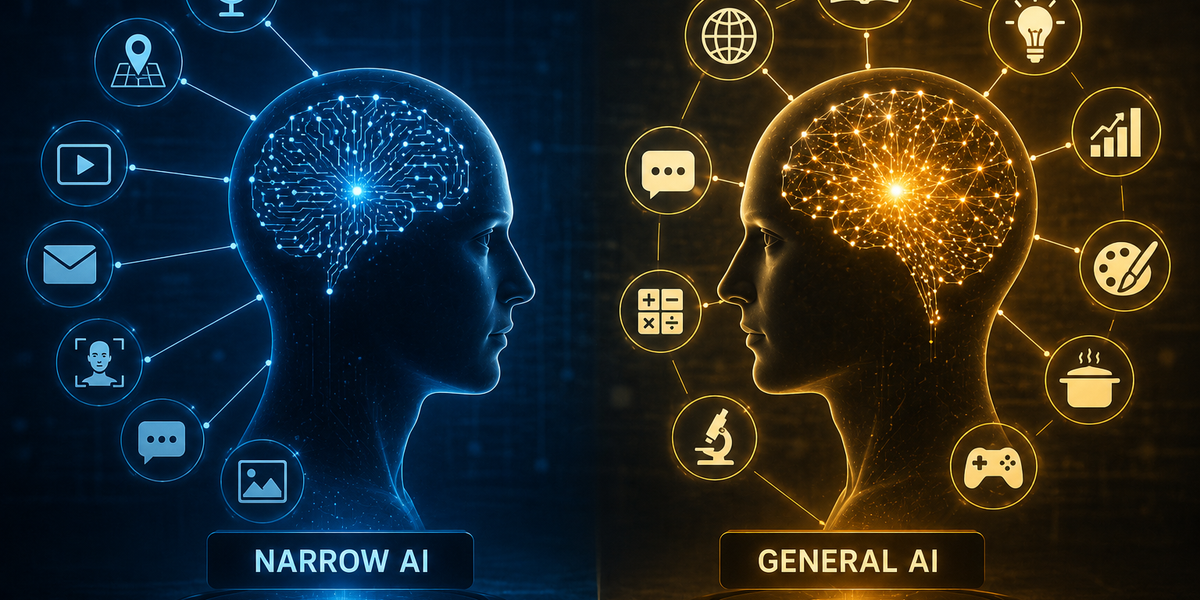
The Difference Between Narrow AI and General AI
Artificial intelligence is becoming part of everyday life. It helps us unlock our phones with facial recognition, recommends movies, translates languages, writes emails, and even answers questions in natural conversation.
Because AI is becoming so capable, it’s easy to assume that today’s systems can think like humans.
They can’t.
In reality, almost every AI system we use today belongs to a category known as Narrow AI. The idea of an AI that can think, learn, and perform almost any intellectual task like a human belongs to a very different category called General AI.
Understanding the difference between these two concepts is essential for understanding where AI is today—and where it might go in the future.
What is Narrow AI?
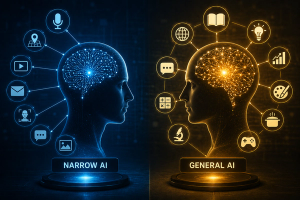
Narrow AI, sometimes called Weak AI, is designed to perform specific tasks.
It can become extremely good at one particular job, but it cannot easily transfer that knowledge to completely different tasks.
For example, an AI system trained to recognize faces cannot suddenly learn to drive a car or write a novel without being specifically developed for those purposes.
Today’s AI systems are highly specialized. Each one is built to solve a particular problem, whether that’s translating languages, recommending products, detecting spam emails, or generating text.
Despite their impressive abilities, they don’t truly understand the world in the way humans do.
Examples of Narrow AI
You probably use Narrow AI many times every day without realizing it.
Some common examples include:
- Voice assistants that answer questions and set reminders.
- Navigation apps that calculate the fastest route.
- Recommendation systems on streaming platforms and online stores.
- Spam filters that identify unwanted emails.
- Facial recognition used to unlock smartphones.
- AI chatbots that answer customer support questions.
- Image generators that create artwork from text prompts.
Each of these systems excels at a specific task.
However, if you asked a navigation app to compose music or a spam filter to translate a language, it wouldn’t know where to begin.
That’s because Narrow AI is designed for focused expertise, not general intelligence.
What is General AI?
General AI, sometimes called Artificial General Intelligence (AGI), refers to a theoretical type of AI that could perform almost any intellectual task that a human can.
Instead of specializing in one area, General AI would be able to learn new skills, adapt to unfamiliar situations, solve problems across different subjects, and apply knowledge from one area to another.
Imagine an AI that could:
- Learn a new language without being specifically retrained.
- Write a business plan.
- Solve a complex scientific problem.
- Teach a child mathematics.
- Cook a meal after reading a recipe.
- Design a video game.
- Switch naturally between all of these tasks.
This kind of flexibility is something humans do remarkably well.
Current AI systems do not.
Why today’s AI isn’t General AI
Modern AI can certainly appear intelligent.
A chatbot can explain history, write poetry, summarize articles, and answer technical questions. An image generator can create artwork in countless styles.
But these abilities can be misleading.
Current AI doesn’t possess general understanding, self-awareness, or independent reasoning like a person.
Instead, it recognizes patterns learned during training and generates responses based on those patterns.
It cannot independently decide to pursue new goals, develop genuine curiosity, or learn entirely new domains on its own in the same way humans can.
This is why today’s AI is still considered Narrow AI, even if it performs many different tasks within a single application.
Why General AI is so difficult
Building General AI is one of the biggest challenges in computer science.
Human intelligence is extraordinarily flexible.
People can apply lessons learned in one situation to completely different problems. We combine logic, creativity, memory, intuition, emotions, and common sense in ways that scientists still don’t fully understand.
Replicating that level of adaptability in machines is far more difficult than teaching a computer to perform one specific task extremely well.
Researchers continue to make significant advances, but no true General AI currently exists.
Could General AI become reality?
Experts disagree on when—or even if—General AI will be achieved.
Some believe rapid advances in computing power and AI research could eventually make it possible.
Others argue that human intelligence involves qualities that current approaches cannot easily reproduce.
Regardless of the timeline, General AI remains an active area of research rather than an existing technology.
For now, discussions about AGI are largely focused on future possibilities rather than current capabilities.
Why the distinction matters
Understanding the difference between Narrow AI and General AI helps set realistic expectations.
When headlines suggest that AI is becoming smarter than humans, they’re often referring to systems that outperform people in highly specific tasks.
For example, an AI may play chess better than any human, identify certain medical conditions with remarkable accuracy, or generate realistic images from text.
None of those achievements mean the AI possesses general intelligence.
It simply means it has become exceptionally skilled within a limited area.
Recognizing this distinction helps separate today’s reality from science fiction.
The future of artificial intelligence
Artificial intelligence is advancing at an incredible pace.
Narrow AI continues to improve, becoming more accurate, more useful, and more integrated into daily life. It is already transforming healthcare, education, transportation, finance, entertainment, and countless other industries.
General AI, however, remains a future goal rather than a present-day technology.
Whether it arrives in the coming decades or much further into the future, it represents a fundamentally different level of capability.
Two types of AI, two very different ideas
Although the terms are sometimes confused, Narrow AI and General AI describe two very different concepts.
Narrow AI is the technology we use today. It’s designed for specific tasks and can perform them exceptionally well, but it cannot think or learn like a human across unrelated domains.
General AI is the idea of a machine with broad, human-like intelligence—one capable of learning, reasoning, adapting, and solving problems across virtually any field.
Today’s AI is powerful, but it is still specialized.
Understanding that difference makes it much easier to appreciate both the remarkable progress AI has already made and the challenges that still lie ahead.