
What “Training” an AI Model Actually Means
When people hear that an AI model has been “trained,” it’s easy to imagine something similar to teaching a student in a classroom. The word itself suggests learning, practice, and gradual improvement.
In reality, AI training is a little different—but the basic idea is surprisingly similar.
Training is the process of teaching an artificial intelligence model to recognize patterns by exposing it to enormous amounts of data. It’s the reason an AI chatbot can answer questions, an image generator can create artwork, or a navigation app can predict the fastest route home.
Without training, an AI model wouldn’t know how to perform any useful task. It would simply be a collection of computer code with no understanding of language, images, or patterns.
Here’s what “training” actually means, step by step.
Step 1: The model starts knowing almost nothing
Before training begins, an AI model has no real understanding of the task it’s meant to perform.
It doesn’t know how sentences are formed, what a cat looks like, or how to recognize a face in a photograph.
You can think of it as a blank canvas.
The model already has the architecture—the mathematical framework that allows it to learn—but it hasn’t yet learned the patterns needed to generate useful results.
Training is what fills in that knowledge.
Step 2: The model is given enormous amounts of data
Every AI model learns from data.
The type of data depends on what the model is designed to do.
For example:
- A language model learns from large collections of written text.
- An image model learns from millions of pictures.
- A speech recognition system learns from audio recordings.
- A recommendation system learns from user behavior and preferences.
The goal isn’t for the AI to memorize every example.
Instead, it looks for patterns that appear again and again.
Over time, it begins to understand how different pieces of information are related.
Step 3: The model makes predictions
Training is largely a process of making predictions.
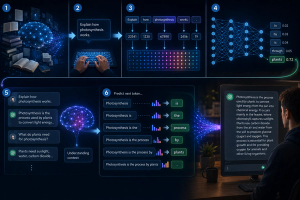
Imagine showing the AI part of a sentence like:
“The Earth revolves around the…”
The model predicts what should come next.
At first, its guesses are often wrong.
It might predict a completely unrelated word because it hasn’t learned much yet.
The same idea applies to image models, which may initially struggle to identify objects correctly.
Early predictions are expected to be inaccurate.
That’s how learning begins.
Step 4: The model learns from its mistakes
After each prediction, the AI compares its answer with the correct one.
If it makes a mistake, it adjusts millions—or even billions—of tiny internal values that influence future predictions.
These adjustments are extremely small.
One incorrect prediction doesn’t suddenly make the model intelligent.
Instead, every correction improves it just a little.
This cycle repeats continuously:
- Make a prediction.
- Measure how accurate it was.
- Adjust the model.
- Try again.
Over time, these tiny improvements accumulate into impressive capabilities.
Step 5: The process repeats billions of times
One prediction isn’t enough.
Or even a thousand.
Modern AI models may repeat this learning process billions of times while processing enormous amounts of data.
Each pass through the data helps the model recognize patterns more accurately.
Gradually, it learns grammar, relationships between words, visual features in images, or other information depending on the task.
This repetitive learning process is one reason AI training requires so much computing power.
Step 6: Training finishes, and the model is ready to use
Once training is complete, the model enters a different stage called inference.
Inference simply means using what the model has already learned.
When you ask an AI chatbot a question or request an image, the model isn’t training itself at that moment.
Instead, it’s applying the patterns it learned during training to generate a response.
Think of it like preparing for an exam.
Studying is the training phase.
Taking the exam is inference.
The learning happened beforehand.
Why training takes so long
Training modern AI models is one of the most demanding tasks in computing.
Some models require weeks or even months of continuous computation using thousands of powerful processors working together.
That’s because they must analyze enormous datasets while making and correcting countless predictions.
Although using AI often feels instantaneous, the learning process behind it is anything but.
The heavy work happens long before the model becomes available to the public.
Better data creates better AI
The quality of an AI model depends heavily on the quality of the data it learns from.
If the training data is diverse, accurate, and well-organized, the model is more likely to perform well across different situations.
If the data contains errors, biases, or missing information, those issues can affect the model’s responses.
This is why collecting, cleaning, and organizing training data is one of the most important parts of developing AI systems.
Good training isn’t just about having more data—it’s about having better data.
The foundation of modern AI
Every impressive AI system begins with training.
Whether it’s recognizing speech, generating realistic images, recommending movies, translating languages, or answering questions, the model first has to learn from enormous amounts of data.
It doesn’t learn by memorizing information the way people often imagine. Instead, it gradually becomes better at recognizing patterns through repeated prediction and correction.
The mathematics behind AI training is incredibly sophisticated, but the underlying idea is simple: practice, make mistakes, improve, and repeat.
The next time you hear that an AI model has been “trained,” you’ll know that it wasn’t taught in a classroom. It became capable through billions of learning steps, each one helping it better understand the patterns hidden within data.