How Large Language Models Like ChatGPT Generate Text
Artificial intelligence can now write emails, summarize articles, answer questions, generate code, and even help brainstorm creative ideas. It often feels like you’re chatting with someone who understands exactly what you’re asking.
But what’s actually happening behind the scenes?
Contrary to popular belief, Large Language Models (LLMs) like ChatGPT don’t search the internet every time you ask a question, and they don’t think the way humans do. Instead, they generate text by recognizing patterns in language that they learned during training.
The technology behind these models is incredibly advanced, but the basic idea is surprisingly easy to understand. Let’s break it down step by step.
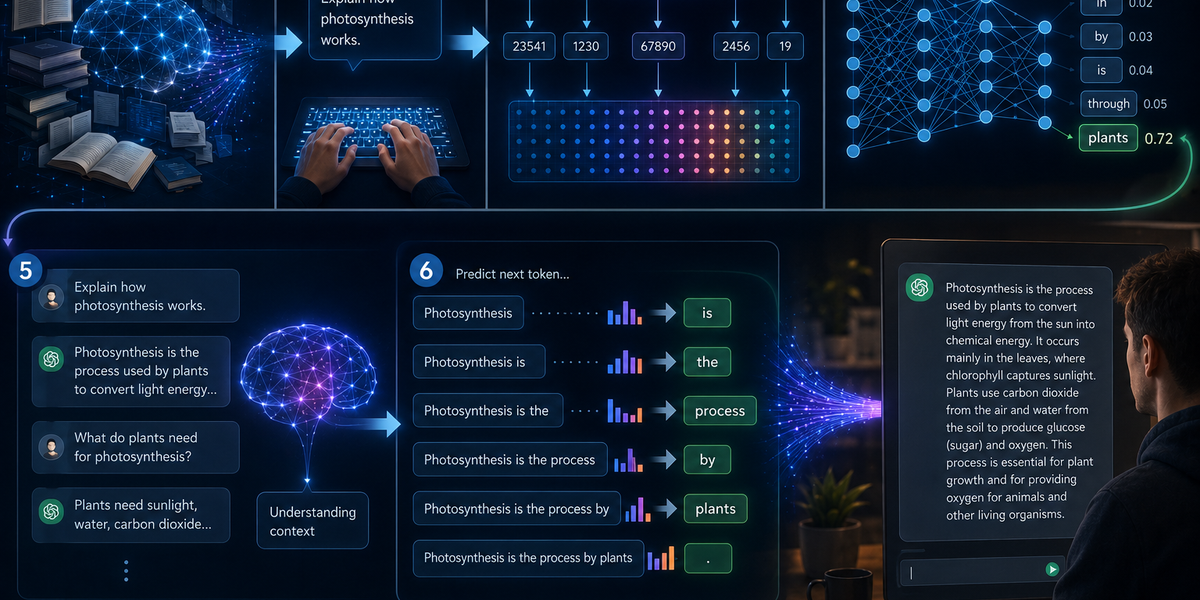
Step 1: The model is trained on enormous amounts of text
Before an AI can generate text, it first goes through a process called training.
During training, the model analyzes an enormous collection of text from books, articles, websites, and other written sources. Rather than memorizing every sentence, it learns how words, phrases, and ideas relate to one another.
For example, it learns that words like “coffee,” “morning,” and “cup” often appear together. It also learns grammar, sentence structure, writing styles, and common patterns in human language.
This training process can take weeks or even months using thousands of powerful computers working together.
By the end of training, the model has learned statistical patterns that help it generate natural-sounding text.
Step 2: You enter a prompt
Everything begins with your prompt.
A prompt can be a question, a request, a sentence, or even just a few words.
For example:
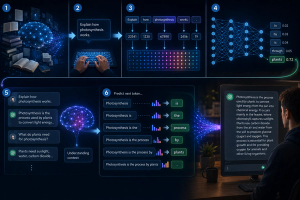
- “Explain how photosynthesis works.”
- “Write a birthday message.”
- “Summarize this article.”
- “Give me dinner ideas.”
The model first processes your prompt to understand the context and determine what kind of response you’re looking for.
The more specific your prompt, the easier it is for the model to generate a useful answer.
Step 3: The prompt is converted into tokens
Computers don’t naturally understand words the way humans do.
Instead, your prompt is broken into smaller units called tokens.
A token might be a whole word, part of a word, punctuation, or even a single character, depending on the language and the model.
These tokens are then converted into numbers that the AI can process mathematically.
Although this happens almost instantly, it’s a crucial step because it allows the model to work with language in a form computers understand.
Step 4: The model predicts what comes next
This is where the real magic happens.
Large Language Models don’t retrieve pre-written answers from a giant database. Instead, they generate text by predicting the most likely next token based on everything you’ve written so far.
Imagine you type:
“The capital of France is…”
The model predicts that “Paris” is the most likely next token.
Then it considers the updated sentence and predicts the following token.
This process repeats over and over, one token at a time.
Although you see complete sentences appearing smoothly on your screen, the model is actually making thousands of tiny predictions every second.
Step 5: Context keeps the conversation coherent
One reason modern AI feels conversational is that it pays attention to context.
Instead of looking only at your latest sentence, the model also considers the earlier parts of the conversation.
For example, if you’ve been discussing computers and then ask, “How much RAM do I need?”, the model understands that you’re referring to computer memory rather than something else.
This ability to use context allows AI to answer follow-up questions, stay on topic, and produce responses that feel connected rather than random.
Step 6: The response is generated
As the model continues predicting one token after another, those tokens gradually form complete words, sentences, and paragraphs.
The response is generated in real time.
Depending on the complexity of the question, the model may produce just a few sentences or several pages of text.
The process is incredibly fast because all of the heavy learning happened during training. During a conversation, the model is simply applying what it has already learned.
Why AI sometimes makes mistakes
Although Large Language Models are remarkably capable, they aren’t perfect.
Because they generate text by predicting likely sequences rather than verifying facts, they can occasionally produce incorrect or outdated information.
This doesn’t mean the AI is intentionally misleading anyone.
It’s simply generating the response that appears most likely based on the patterns it learned during training.
For this reason, it’s always wise to verify important information, especially when it relates to health, law, finance, or other high-stakes topics.
Why Large Language Models are so useful
Despite their limitations, LLMs have become powerful tools because they can understand and generate natural language across an enormous range of tasks.
Today, they can help people:
- Answer questions
- Write articles and emails
- Summarize long documents
- Generate computer code
- Brainstorm ideas
- Translate languages
- Explain complex topics in simple terms
Instead of replacing human thinking, they often work best as assistants that help people save time and improve productivity.
More prediction than conversation
Talking to an AI can feel surprisingly natural, but behind every response is a sophisticated prediction process.
Large Language Models learn patterns from vast amounts of text during training. When you ask a question, they analyze your prompt, convert it into tokens, consider the context, and predict one token after another until a complete response is formed.
The result is writing that often feels remarkably human, even though it’s created through mathematics, statistics, and pattern recognition rather than human thought.
The next time you ask ChatGPT a question, remember that you’re not watching it retrieve a stored answer. You’re watching it build a response from scratch—one carefully predicted token at a time.