
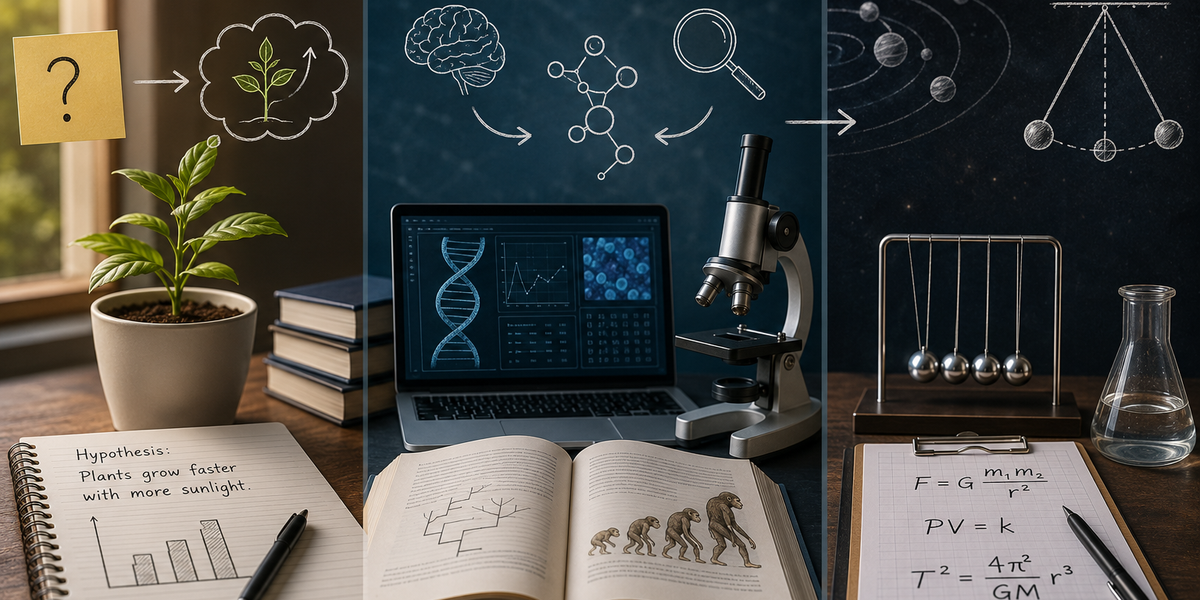
The Difference Between Theory, Hypothesis, and Law
The words theory, hypothesis, and law are often used interchangeably in everyday conversation. Someone might say, “I have a theory,” when they really mean a guess, or assume that a scientific law is simply a theory that has been proven.
In science, however, these three terms have very different meanings.
A hypothesis is a proposed explanation that can be tested. A theory is a well-supported explanation based on a large body of evidence. A law is a description of a pattern or relationship that consistently occurs in nature.
None is “better” than the others—they simply answer different scientific questions.
Understanding the difference helps explain how science works and why these terms are so important.
A hypothesis is an educated prediction
Scientific discoveries often begin with a question.
Why do plants grow better in sunlight? Why do some diseases spread more quickly than others? What causes a certain chemical reaction?
A scientist first develops a hypothesis—an educated explanation or prediction that can be tested through observation or experimentation.
For example:
“Plants grow faster because they receive more sunlight.”
This statement isn’t accepted as true simply because someone suggested it.
Instead, scientists design experiments to test whether the hypothesis is supported by evidence.
A good hypothesis must be testable and capable of being proven wrong if the evidence doesn’t support it.
Testing is the heart of science
Once a hypothesis has been proposed, researchers collect evidence.
They perform experiments, make observations, analyze results, and compare their findings with those of other scientists.
Sometimes the evidence supports the hypothesis.
Sometimes it doesn’t.
In either case, valuable knowledge is gained.
Many hypotheses are revised, improved, or rejected as new evidence becomes available.
This willingness to test ideas—and change them when necessary—is one of the defining features of science.
A theory explains why something happens
If a hypothesis is repeatedly supported by evidence from many independent studies, it may contribute to the development of a scientific theory.
A theory is not a guess.
In science, a theory is a comprehensive explanation that is supported by a large body of evidence collected over many years.
Scientific theories explain why or how something happens.
For example:
- The theory of evolution explains how species change over time.
- Germ theory explains how microorganisms cause many diseases.
- The theory of plate tectonics explains why continents move and why earthquakes occur.
These theories are among the strongest explanations in science because they have been tested repeatedly and consistently supported by evidence.
A law describes what happens
A scientific law is different from a theory.
Instead of explaining why something happens, a law describes what happens under certain conditions.
Scientific laws often describe consistent patterns or relationships observed in nature.
For example:
- Newton’s Law of Universal Gravitation describes how objects attract one another.
- Boyle’s Law describes the relationship between the pressure and volume of a gas.
- Kepler’s Laws of Planetary Motion describe how planets move around the Sun.
Many scientific laws can be expressed as mathematical equations because they describe predictable relationships.
However, a law does not necessarily explain the underlying reason those relationships exist.
Theories do not become laws
One of the biggest misconceptions in science is the belief that a theory eventually becomes a law after enough evidence is collected.
This is not true.
Theories and laws serve different purposes.
A law describes what happens.
A theory explains why it happens.
For example, gravity can be described by scientific laws that predict how objects move.
At the same time, scientific theories help explain the underlying nature of gravity.
One does not replace the other.
Both are valuable parts of scientific understanding.
Evidence strengthens theories
Scientific theories remain open to testing.
As new evidence becomes available, theories can be refined, expanded, or adjusted.
This doesn’t mean they’re unreliable.
In fact, the willingness to improve explanations based on new evidence is one of science’s greatest strengths.
Some theories have remained strongly supported for more than a century because repeated research continues to confirm their predictions.
Scientific knowledge grows by continually testing and improving our understanding of the world.
Everyday language versus scientific language
Much of the confusion comes from how these words are used outside science.
In everyday conversation, people often use “theory” to mean a hunch or personal opinion.
In science, however, a theory represents one of the highest levels of explanation supported by evidence.
Similarly, people sometimes assume that “law” means absolute certainty.
Scientific laws describe observations that have consistently been supported, but scientists remain open to refining their understanding if new evidence emerges.
Scientific terms often have much more precise meanings than their everyday use suggests.
Why these distinctions matter
Understanding the difference between hypotheses, theories, and laws helps us better appreciate how scientific knowledge develops.
Science isn’t built on opinions or isolated experiments.
It advances through careful observation, repeated testing, independent verification, and continuous improvement.
Each stage plays an important role.
Hypotheses encourage investigation.
Theories provide explanations.
Laws describe predictable patterns.
Together, they help scientists understand the natural world.
Three ideas working together
Although they’re closely connected, hypotheses, theories, and laws are not different stages of the same process.
A hypothesis is a testable idea that begins an investigation.
A theory is a well-supported explanation built upon extensive evidence.
A law is a description of a consistent pattern observed in nature.
Each answers a different scientific question, and each contributes to our understanding in its own way.
The next time you hear someone say, “It’s just a theory,” you’ll know that in science, a theory isn’t “just” anything. It’s one of the strongest and most carefully tested explanations we have for how the world works.