
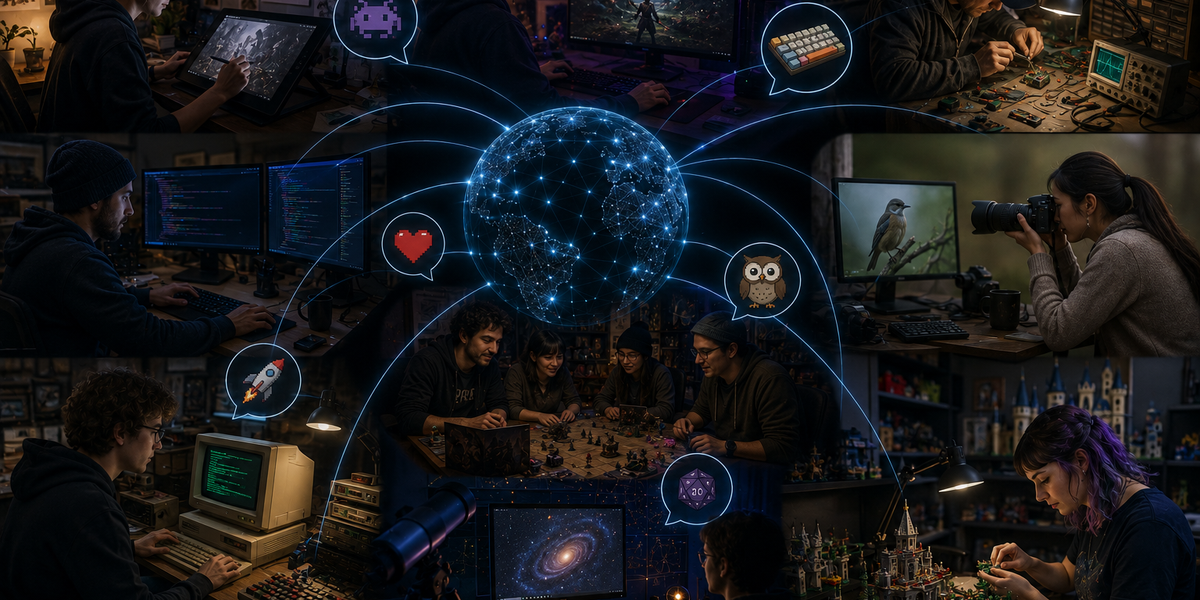
The Strange World of Internet Subcultures
The internet is often described as one giant connected world. In reality, it’s more like millions of small neighborhoods.
While social media platforms and popular websites attract billions of users, countless smaller communities exist beneath the surface, each with its own language, traditions, humor, and unwritten rules. These online groups—known as internet subcultures—bring together people who share interests that range from the everyday to the wonderfully unusual.
Some focus on art, technology, books, or gaming. Others are built around vintage computers, mechanical keyboards, bird photography, urban exploration, or restoring old electronics.
What makes internet subcultures fascinating isn’t just what people are interested in—it’s how these communities create their own identities and cultures.
What is an internet subculture?
An internet subculture is a community that forms around a shared interest, hobby, style, or way of thinking.
Unlike traditional communities, members don’t need to live in the same city—or even the same country. Someone in Brazil can exchange ideas with someone in Japan or Finland as easily as they can with a neighbor.
Most internet subcultures develop their own vocabulary, inside jokes, traditions, and favorite platforms. To newcomers, these communities can seem confusing at first, but for members, they create a strong sense of belonging.
The internet has made it easier than ever for people with niche interests to find one another.
Tiny hobbies can become global communities
Before the internet, having an unusual hobby could feel isolating.
Today, almost every interest has an online community.
There are groups dedicated to repairing vintage game consoles, building custom mechanical keyboards, collecting fountain pens, designing miniature models, astrophotography, speedcubing, retro computing, and countless other hobbies.
Many of these communities are surprisingly large, with members sharing tutorials, advice, reviews, and creative projects every day.
What once might have been a solitary pastime has become a global conversation.
Every community develops its own language
Spend enough time in almost any online community, and you’ll notice something interesting.
People begin using words and phrases that make perfect sense within the group but sound confusing to outsiders.
Gamers, programmers, photographers, artists, and hobbyists all develop their own shorthand, technical terms, and memes.
This shared language helps members communicate efficiently while also creating a sense of identity.
Learning the vocabulary often becomes part of joining the community itself.
Memes help build culture
Memes are much more than funny pictures.
Within internet subcultures, they’re often a way of expressing shared experiences, celebrating achievements, or gently poking fun at common frustrations.
A meme that makes one community laugh might be completely meaningless to someone outside it.
Over time, these jokes become part of the group’s history, creating a culture that evolves alongside the community.
In many cases, memes spread far beyond their original audience and eventually become part of mainstream internet culture.
Online communities encourage learning
One of the most valuable aspects of internet subcultures is how much knowledge they share.
People who are passionate about a subject often enjoy helping newcomers.
Whether someone wants to build their first computer, learn digital illustration, understand astronomy, or restore an old camera, there’s often an online community ready to offer advice.
Forums, discussion groups, videos, and collaborative projects have made learning more accessible than ever.
Many people develop professional skills simply by participating in communities built around shared interests.
Not every subculture stays small
Some internet communities remain niche for years.
Others suddenly become mainstream.
Video game streaming, mechanical keyboards, podcasts, anime, tabletop gaming, and digital art communities all began as relatively specialized interests before attracting much larger audiences.
As platforms grow and trends spread, subcultures sometimes influence fashion, entertainment, technology, and even business.
Ideas that begin in small online communities can eventually shape popular culture.
Challenges of online communities
Like any community, internet subcultures aren’t perfect.
Some become so focused on their own interests that they can unintentionally discourage newcomers. Others may struggle with misinformation, heated debates, or disagreements about how the community should evolve.
Healthy communities generally encourage respectful discussion, welcome beginners, and remain open to new ideas.
The strongest groups balance enthusiasm with inclusiveness.
After all, every expert was once a beginner.
Why people keep coming back
At their core, internet subcultures satisfy a basic human need: connection.
People enjoy finding others who share their curiosity, creativity, or passion for a particular subject.
Whether it’s discussing the latest science fiction novel, comparing photography techniques, building robots, or solving programming challenges, these communities create spaces where shared interests become shared experiences.
For many members, the friendships formed through these communities become just as meaningful as the hobbies themselves.
A world hidden in plain sight
Although the internet often feels dominated by major social media platforms, some of its most interesting spaces are the smaller communities quietly thriving in the background.
These internet subcultures remind us that the web isn’t just a place to consume content—it’s a place to learn, create, collaborate, and connect with people who share our interests, no matter how unusual they may seem.
The next time you discover an online community devoted to something you’ve never heard of, don’t be surprised.
There’s a good chance thousands of passionate people have already been discussing it for years.
That’s one of the internet’s greatest strengths: no matter how niche your curiosity is, you’re rarely the only person who shares it.