The Best Sci-Fi Books Every Geek Should Read
Science fiction has always been more than spaceships and distant planets. At its best, it asks big questions about humanity, technology, artificial intelligence, time, and the future of civilization. Long before many real-world inventions existed, science fiction writers imagined ideas that would later inspire scientists, engineers, and entrepreneurs.
Whether you’re fascinated by AI, space exploration, dystopian societies, or mind-bending physics, there’s a science fiction novel that will challenge the way you think.
Here are some of the best sci-fi books every geek should consider adding to their reading list.
Classic novels that shaped the genre
Some science fiction books remain influential decades after they were published because they introduced ideas that still feel relevant today.
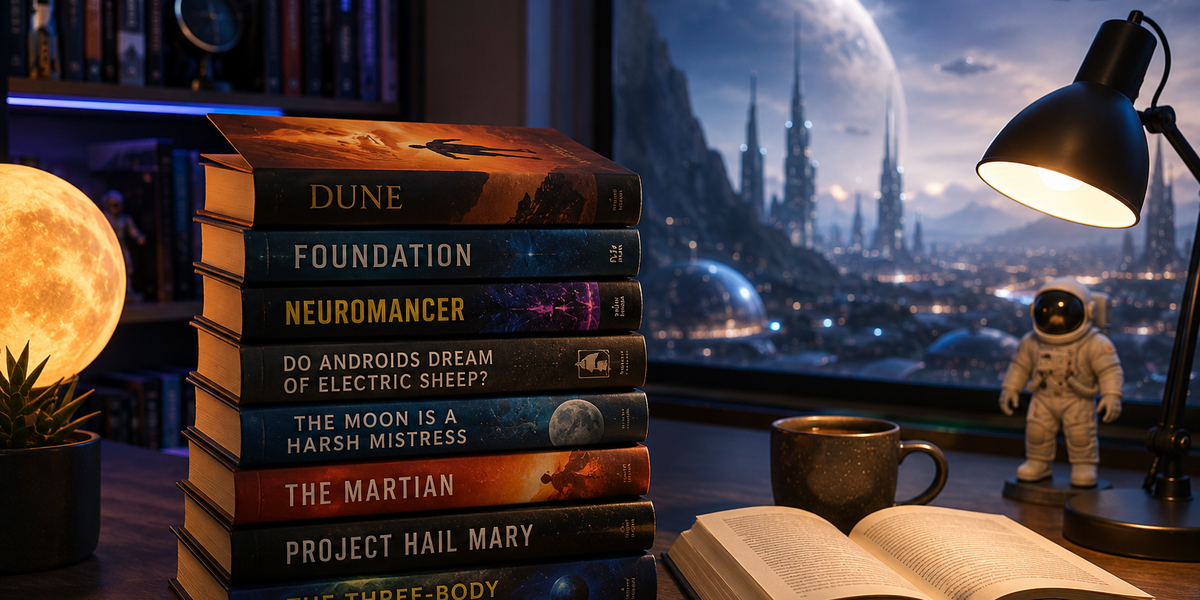
Dune by Frank Herbert explores politics, religion, ecology, and power on the desert planet of Arrakis. Its world-building is so detailed that it has inspired generations of writers and filmmakers.
Foundation by Isaac Asimov imagines the rise and fall of a galactic empire through mathematics and long-term prediction. It remains one of the most influential science fiction series ever written.
Neuromancer by William Gibson introduced many readers to the concept of cyberspace long before the modern internet became part of everyday life. It helped define the cyberpunk genre and influenced countless books, films, and video games.
These classics continue to shape modern science fiction because their ideas extend far beyond technology.
Books that make you think about artificial intelligence
Artificial intelligence has become one of the most fascinating topics in science fiction.
Many novels explore what happens when machines become increasingly intelligent, forcing readers to rethink what it means to be human.
Do Androids Dream of Electric Sheep? by Philip K. Dick asks whether empathy is what truly separates humans from machines. It later inspired the iconic film Blade Runner.
The Moon Is a Harsh Mistress by Robert A. Heinlein features a self-aware computer that becomes central to a revolution on the Moon, raising questions about consciousness and freedom.
More recent novels also explore AI through the lens of ethics, identity, and human relationships, showing that the subject remains just as relevant today as it was decades ago.
Stories that explore space on a grand scale
One of science fiction’s greatest strengths is its ability to make readers feel both incredibly small and endlessly curious.
The Martian by Andy Weir combines real science with humor as an astronaut struggles to survive alone on Mars using engineering and creativity.
Project Hail Mary, also by Andy Weir, blends space exploration, first contact, and scientific problem-solving into an adventure that’s both exciting and surprisingly emotional.
For readers who enjoy hard science fiction grounded in realistic physics, these novels offer a perfect balance between scientific accuracy and compelling storytelling.
Mind-bending books that challenge reality
Some science fiction novels leave readers questioning everything they thought they understood.
These stories often explore time travel, alternate realities, memory, or the nature of consciousness.
Books like Ubik by Philip K. Dick blur the line between reality and illusion, while The Three-Body Problem by Liu Cixin introduces breathtaking scientific ideas alongside humanity’s first contact with an alien civilization.
Rather than focusing only on action, these novels encourage readers to think deeply about science, philosophy, and the future.
They’re the kinds of books that stay with you long after you’ve finished the final chapter.
Modern sci-fi is more diverse than ever
Science fiction has expanded dramatically over the past two decades.
Today’s authors explore themes that go beyond robots and spaceships, including climate change, biotechnology, virtual reality, social inequality, and the ethical consequences of emerging technologies.
Many modern novels combine scientific speculation with deeply personal stories, creating characters that feel just as important as the futuristic worlds they inhabit.
As technology continues evolving, contemporary science fiction continues asking new questions about where humanity might be heading.
Why geeks love science fiction
Science fiction appeals to curious minds because it rewards imagination.
Instead of asking, “What is?” it asks, “What if?”
What if humans colonized other planets?
What if artificial intelligence surpassed human intelligence?
What if time travel became possible?
What if we discovered life elsewhere in the universe?
These questions encourage readers to think like scientists, engineers, inventors, and philosophers.
Even when the technology is fictional, the ideas often feel surprisingly plausible.
Science fiction often predicts tomorrow
Many technologies we use today first appeared in science fiction.
Video calls, voice-controlled assistants, wearable technology, tablet computers, autonomous robots, and virtual reality all appeared in novels long before they became reality.
While science fiction doesn’t literally predict the future, it inspires people to imagine what’s possible.
Engineers, researchers, and entrepreneurs frequently cite science fiction as one of the reasons they pursued careers in technology.
In that sense, today’s fiction sometimes becomes tomorrow’s innovation.
There’s a sci-fi book for everyone
One of the best things about science fiction is its variety.
Some novels focus on action-packed adventures across the galaxy. Others explore philosophical questions about consciousness, society, and technology. Some are grounded in realistic science, while others embrace imaginative worlds filled with impossible ideas.
Whether you’re fascinated by artificial intelligence, space exploration, robotics, quantum physics, or future civilizations, there’s a book waiting to capture your imagination.
More than stories about the future
The greatest science fiction books aren’t simply about advanced technology—they’re about people.
They explore curiosity, ambition, fear, survival, ethics, and the choices humanity might face as technology continues to evolve.
That’s why so many of these novels remain relevant decades after they were written.
They remind us that while technology changes rapidly, the questions we ask about ourselves often remain the same.
If you’re looking for books that entertain, challenge your thinking, and inspire your imagination, science fiction remains one of the richest genres you’ll ever explore.