The Difference Between AI, Machine Learning, and Deep Learning
Artificial intelligence, machine learning, and deep learning are three terms that are often used interchangeably. News articles, product launches, and technology companies frequently mention them together, making it easy to assume they all mean the same thing.
They don’t.
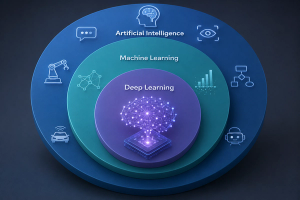
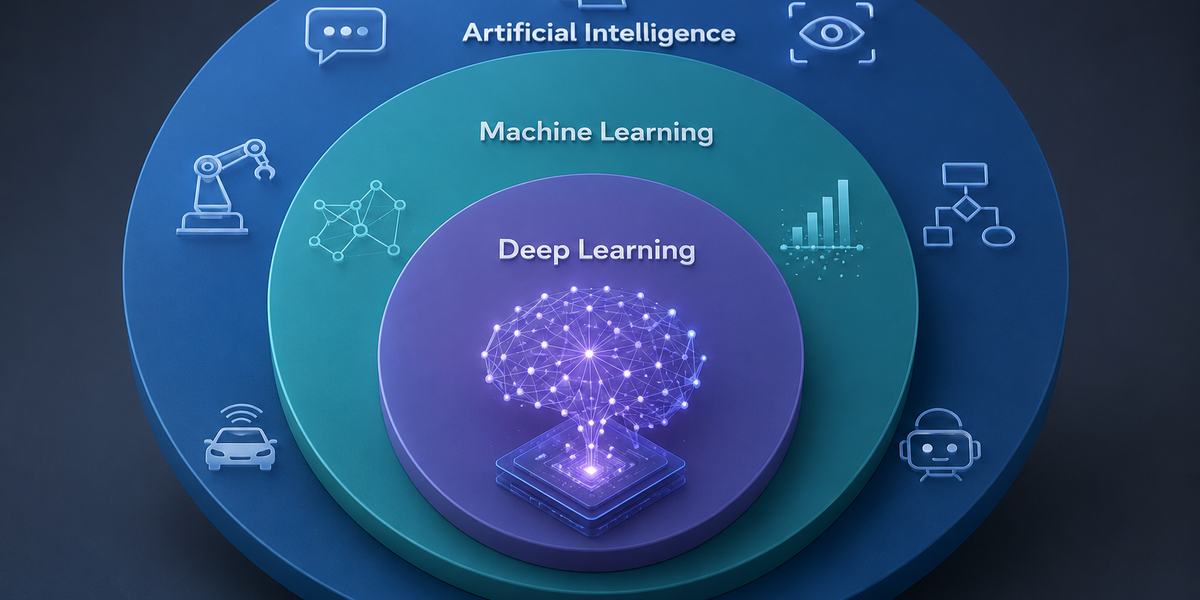
Although they’re closely related, each term refers to a different concept. In fact, you can think of them as three nested layers: artificial intelligence is the broadest field, machine learning is a branch of AI, and deep learning is a specialized type of machine learning.
Understanding the difference doesn’t require a degree in computer science. Once you see how they fit together, the terminology becomes much easier to understand.
Artificial intelligence is the big picture
Artificial intelligence, or AI, is the broad field of creating computers that can perform tasks normally associated with human intelligence.
These tasks might include recognizing speech, understanding language, making decisions, solving problems, or identifying objects in images.
Importantly, AI doesn’t always involve learning from data.
Some AI systems simply follow rules that human programmers have written. For example, an early chess program might evaluate every possible move based on predefined instructions rather than learning from experience.
In other words, AI is the overall goal: creating machines that can perform intelligent tasks.
Machine learning helps computers learn from data
Machine learning is one way of achieving artificial intelligence.
Instead of programming every rule manually, developers provide the computer with large amounts of data so it can discover patterns on its own.
Imagine teaching someone to recognize apples.
With traditional programming, you might write hundreds of rules:
- Apples are usually round.
- Apples can be red, green, or yellow.
- Apples have stems.
- Apples have smooth skin.
With machine learning, you simply show the computer thousands of pictures labeled “apple” and “not apple.”
Over time, it learns the patterns by itself.
This approach allows computers to improve their performance without needing explicit instructions for every situation.
Deep learning takes machine learning further
Deep learning is a specialized form of machine learning inspired by the structure of the human brain.
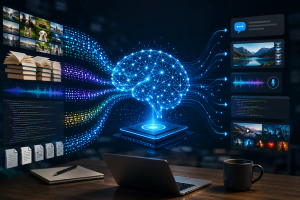
It uses large systems called artificial neural networks to process enormous amounts of information and recognize highly complex patterns.
Unlike traditional machine learning, deep learning often requires very little human guidance about which features to look for.
For example, when identifying cats in photos, older machine learning systems might require programmers to specify features like ears, whiskers, or tails.
A deep learning model can often figure out those features automatically after analyzing millions of images.
This ability makes deep learning especially effective for difficult tasks such as image recognition, speech recognition, language translation, and modern AI chatbots.
A simple way to picture the difference
One of the easiest ways to understand these technologies is to imagine three circles inside one another.
- Artificial Intelligence is the largest circle.
- Machine Learning is a smaller circle inside AI.
- Deep Learning is an even smaller circle inside machine learning.
That means:
- Every deep learning system is also machine learning.
- Every machine learning system is part of artificial intelligence.
- But not every AI system uses machine learning.
- And not every machine learning system uses deep learning.
This relationship is the source of much of the confusion surrounding these terms.
Where you use them every day
You probably interact with all three more often than you realize.
Artificial intelligence powers virtual assistants, recommendation systems, navigation apps, customer support chatbots, and smart home devices.
Machine learning helps detect spam emails, recommend movies, predict traffic, identify fraudulent credit card transactions, and personalize online shopping experiences.
Deep learning enables facial recognition, voice assistants, language translation, image generation, self-driving vehicle research, and modern AI tools capable of writing text or generating images.
Although these technologies work differently behind the scenes, they’re all designed to make computers perform tasks more intelligently.
Why deep learning has become so popular
Deep learning has driven many of the biggest AI breakthroughs of the past decade.
There are several reasons for this.
First, computers today are powerful enough to process enormous amounts of information.
Second, the internet has created vast quantities of data that AI systems can learn from.
Finally, improvements in graphics processing units (GPUs) have made it possible to train extremely large neural networks much faster than before.
Together, these advances have allowed deep learning systems to achieve remarkable performance in tasks that were once considered extremely difficult for computers.
Which one is the future?
The answer is all three.
Artificial intelligence remains the overall field focused on building intelligent systems.
Machine learning continues to be one of the most widely used approaches for developing AI applications.
Deep learning is driving many of today’s most advanced technologies, particularly in areas involving images, language, speech, and complex pattern recognition.
As computing power continues to improve and more data becomes available, all three fields will continue evolving together.
Three terms, one connected story
The difference between AI, machine learning, and deep learning is much simpler than it first appears.
Artificial intelligence is the broad goal of making machines perform intelligent tasks. Machine learning is a technique that allows computers to learn from data instead of relying solely on programmed rules. Deep learning is a powerful type of machine learning that uses artificial neural networks to solve especially complex problems.
Together, these technologies are transforming everything from healthcare and finance to education, transportation, and entertainment.
The next time you hear one of these terms in the news, you’ll know exactly where it fits—and why they’re connected, but not interchangeable.