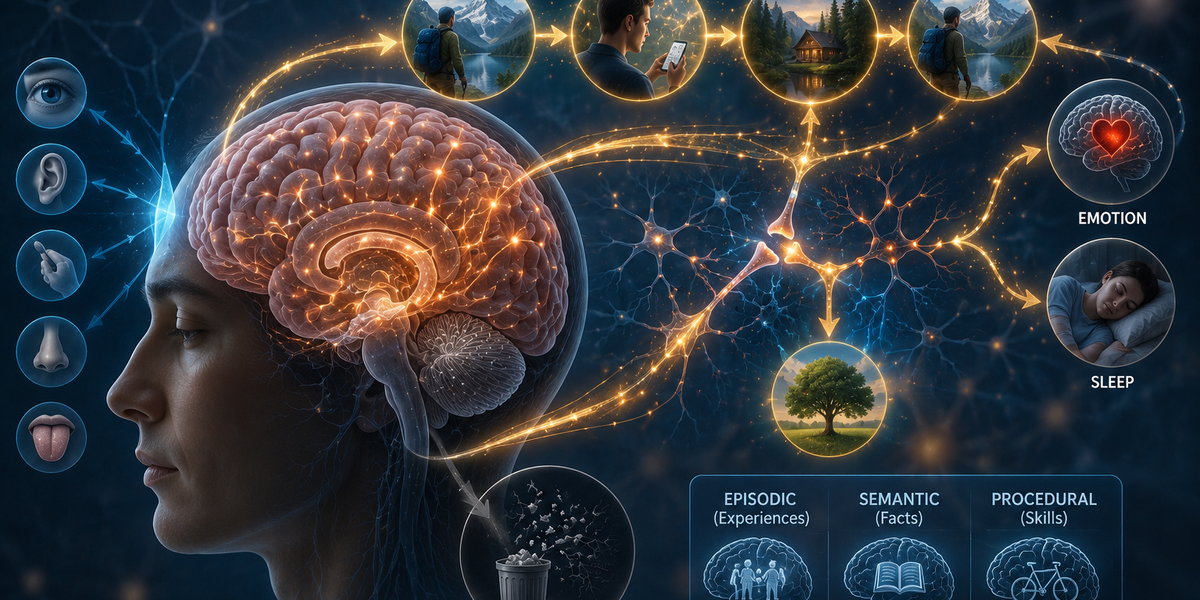
How Memory Really Works in the Brain
Memory is something we rely on every single day.
It helps us remember a friend’s name, recognize a familiar face, recall where we parked the car, and learn new skills throughout our lives. Without memory, even the simplest daily tasks would become incredibly difficult.
Yet memory isn’t like a video camera that records every moment exactly as it happened.
Instead, the brain actively builds, stores, updates, and sometimes even changes memories over time. This is one reason two people can remember the same event differently, or why you might clearly remember certain moments from childhood while forgetting what you had for lunch two days ago.
Scientists have spent decades studying how memory works, and while many questions remain, they now understand much more about the remarkable processes taking place inside the brain.
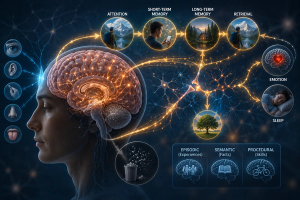
Memory begins with attention
Before something can become a memory, you first have to notice it.
Your brain receives an enormous amount of information every second through your eyes, ears, skin, nose, and other senses. If it tried to remember everything, it would quickly become overwhelmed.
Instead, attention acts like a filter.
When something captures your focus—a conversation, a new fact, an unusual event, or an emotional experience—your brain gives it a much better chance of being remembered.
This is why it’s often difficult to remember information if you’re distracted while learning it.
Attention is the first step in creating a memory.
Short-term memory holds information temporarily
Once you’ve paid attention to something, it usually enters short-term memory.
This is your brain’s temporary workspace.
Short-term memory allows you to remember a phone number long enough to dial it, follow directions someone just gave you, or keep track of the beginning of a sentence while reading the end.
However, this type of memory is limited.
Without repetition or further processing, much of the information disappears within seconds or minutes.
Only a small portion eventually moves into long-term memory.
Long-term memories are built over time
Information becomes part of long-term memory when the brain decides it’s important enough to keep.
This process is called memory consolidation.
Rather than storing memories in one single location, the brain creates networks connecting different pieces of information.
For example, remembering your graduation might involve separate brain regions responsible for faces, emotions, sounds, locations, and language.
Together, these connections create the memory you can later recall.
The stronger these connections become, the easier the memory is to retrieve.
Sleep helps strengthen memories
One of the brain’s most important memory-building activities happens while you’re asleep.
During sleep—especially deep sleep—your brain reviews and strengthens many of the experiences from the day.
Researchers believe this process helps transfer important information into long-term storage while removing details that are less useful.
This is one reason students are often encouraged to get enough sleep before exams.
Learning doesn’t stop when you go to bed.
In many ways, your brain continues organizing what you’ve learned throughout the night.
Emotion makes memories stronger
Have you ever noticed how vividly you remember important life events?
That’s because emotion has a powerful effect on memory.
Experiences involving excitement, fear, joy, surprise, or sadness are often remembered more clearly than ordinary daily events.
When emotions are involved, the brain releases chemicals that strengthen memory formation.
This is why many people can remember where they were during major historical events or important personal milestones, even years later.
Emotion helps signal to the brain that something is worth remembering.
Why we forget things
Forgetting isn’t necessarily a flaw.
In fact, it’s an important part of how memory works.
If your brain remembered every tiny detail of every day, finding important information would become much more difficult.
Instead, the brain constantly filters information, keeping what seems useful while allowing less important details to fade over time.
Sometimes memories also become harder to retrieve because they haven’t been used for a long time.
In many cases, the memory isn’t completely gone—it’s simply more difficult to access.
Memories aren’t perfect recordings
Many people assume memories remain unchanged once they’re stored.
In reality, every time you remember something, your brain rebuilds the memory.
During this process, small details can change.
New experiences, conversations, emotions, or information may subtly influence how an event is remembered later.
This is why eyewitness accounts sometimes differ, even when people experienced the same event.
Memory is surprisingly flexible.
Rather than replaying an exact recording, your brain reconstructs past experiences each time you recall them.
The brain stores different kinds of memories
Not all memories are the same.
Your brain uses different systems for different types of information.
For example:
- Episodic memory stores personal experiences, such as birthdays or vacations.
- Semantic memory stores facts and general knowledge, like knowing that Paris is the capital of France.
- Procedural memory stores skills, such as riding a bicycle or typing on a keyboard.
These different memory systems work together, allowing you to remember both information and experiences while performing everyday tasks almost automatically.
Your memory is always changing
Memory isn’t a fixed storage system.
It’s dynamic, constantly adapting as you learn new information and gain new experiences.
Every conversation, book, skill, and challenge creates opportunities for your brain to strengthen existing connections or build entirely new ones.
This remarkable ability, known as neuroplasticity, allows people to continue learning throughout life.
Your memory is never completely finished—it’s continually evolving.
A remarkable system of learning and remembering
Memory is one of the brain’s most extraordinary abilities.
It allows us to learn from the past, recognize familiar people and places, develop new skills, and build the knowledge that shapes our lives.
Rather than acting like a video recorder, the brain carefully selects information, strengthens important experiences, filters out unnecessary details, and constantly updates what it knows.
Although scientists are still uncovering the full complexity of memory, one thing is clear: every memory you form is the result of billions of brain cells working together in ways that are both incredibly sophisticated and uniquely human.
The next time you remember a childhood moment or learn something new, you’re witnessing one of the most remarkable processes taking place inside your own brain.