How Encryption Keeps Your Data Safe
Every day, you send messages, shop online, check your bank account, log into websites, and store photos in the cloud. Although these activities feel simple, they involve sharing sensitive information across the internet.
So how does that information stay private?
The answer is encryption.
Encryption is one of the most important technologies behind modern digital security. It helps protect everything from passwords and credit card numbers to emails and private conversations. Without it, using the internet would be far riskier than it is today.
The good news is that you don’t need to understand complex mathematics to understand how encryption works. At its core, the idea is surprisingly simple.
What is encryption?
Encryption is the process of converting readable information into a coded format that unauthorized people cannot understand.
Imagine writing a letter using a secret code that only you and the recipient know how to decode. If someone intercepted the letter along the way, they would see only meaningless symbols instead of your actual message.
That’s essentially what encryption does.
Your original information is called plaintext. After it is encrypted, it becomes ciphertext—a scrambled version that appears unreadable unless it is unlocked with the correct key.
Without the proper key, the information is practically useless.
Why encryption matters
Every time you use the internet, your data travels through multiple networks before reaching its destination.
Without encryption, anyone who managed to intercept that data could potentially read it.
Imagine entering your online banking password while connected to public Wi-Fi. If the connection weren’t encrypted, someone could theoretically capture that password while it was traveling across the network.
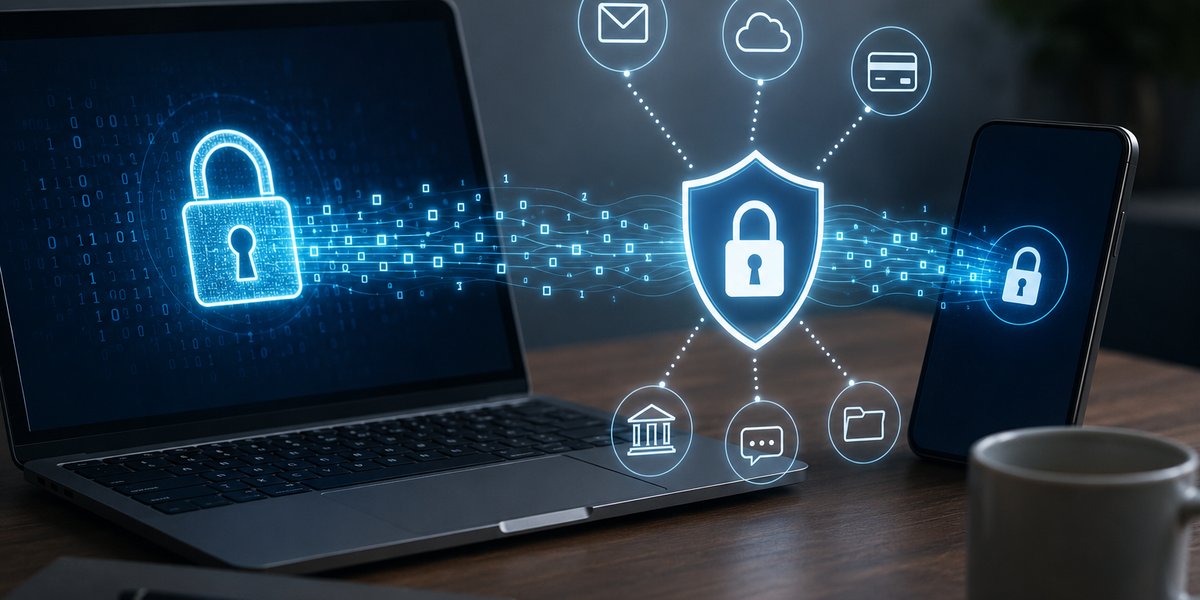
Encryption prevents this by scrambling the data before it leaves your device.
Even if someone intercepts the information, they cannot easily understand it because it has been converted into unreadable code.
This is why encryption is considered one of the foundations of internet security.
Where you use encryption every day
Many people don’t realize how often encryption protects them.
It’s used whenever you:
- Log into your email account
- Shop online with a credit card
- Send messages through secure messaging apps
- Use online banking
- Connect to secure websites
- Store files in many cloud storage services
- Unlock your smartphone
Even something as simple as seeing “https://” at the beginning of a website address usually indicates that communication between your browser and the website is encrypted.
In many cases, encryption works quietly in the background without requiring any action from the user.
How encryption works in simple terms
Think of encryption like locking valuables inside a safe.
Your information goes into the safe before it travels across the internet.
Only someone with the correct key can unlock the safe and read what’s inside.
If the safe is intercepted during delivery, the contents remain protected because the lock cannot easily be opened.
Modern encryption uses advanced mathematical algorithms rather than physical locks, but the basic idea is the same.
Information is locked before it leaves your device and unlocked only after it reaches the intended recipient.
What are encryption keys?
The key is one of the most important parts of encryption.
An encryption key is a piece of digital information used to lock and unlock data.
There are two common approaches.
Symmetric encryption uses the same key for both encrypting and decrypting the information. It’s fast and efficient but requires both parties to securely share the same key.
Asymmetric encryption, also known as public-key encryption, uses two different keys.
One key is public and can be shared openly. The other is private and remains secret.
This allows people to exchange encrypted information without first sharing a secret password.
Many secure websites use both methods together to provide fast and secure communication.
Can encrypted data be hacked?
No security system is perfect, but modern encryption is extremely difficult to break.
Today’s encryption algorithms use keys so large that trying every possible combination would take unimaginably long—even for powerful computers.
In practice, attackers rarely try to break the encryption itself.
Instead, they often target weaker points, such as:
- Weak passwords
- Phishing scams
- Malware
- Stolen devices
- Human error
This is why using strong passwords, enabling two-factor authentication, and keeping devices updated remain important, even when encryption is protecting your data.
Encryption is strongest when combined with good security habits.
Why encryption is becoming more important
As more of our lives move online, encryption has become increasingly essential.
Medical records, financial information, business documents, personal conversations, and even smart home devices all depend on secure communication.
Without encryption, cybercriminals would have a much easier time stealing sensitive information during transmission.
As technology continues to evolve, encryption will remain one of the key tools protecting privacy in the digital world.
It’s one of the reasons billions of people can safely use online services every day.
The invisible shield behind the internet
Encryption is something most people use constantly without ever noticing it.
Every secure login, online payment, private message, and encrypted backup relies on this technology to keep information safe from unauthorized access.
Although the mathematics behind encryption is incredibly sophisticated, the concept itself is simple: turn readable information into unreadable code that only the intended recipient can unlock.
The next time you shop online, send a message, or log into your favorite website, remember that encryption is working quietly behind the scenes.
It’s an invisible layer of protection that helps make today’s connected world possible.